

Reflections on the Oxford Union debate and the problem with suspicion
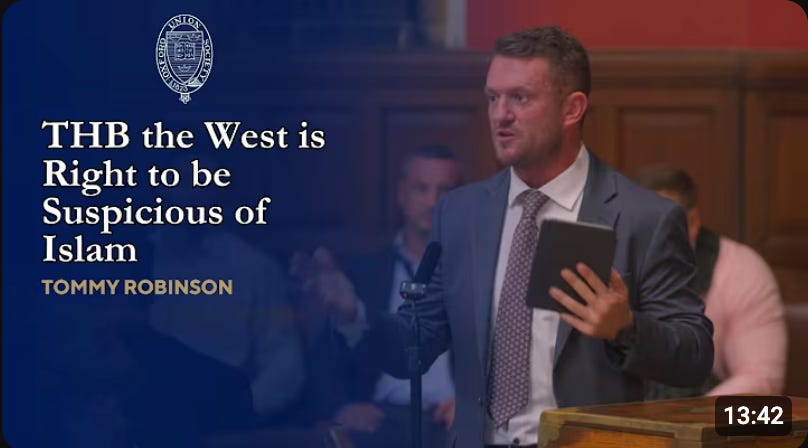
The Oxford Union recently debated whether the West should be suspicious of Islam, with Tommy Robinson arguing in favor of the motion. I encourage people to watch the debate, not necessarily because Robinson presented a particularly strong case, but because it is a useful example of how Islam is often discussed by people who already see Muslims as “the other.” This article is not meant to be a full response to everything said during the debate. Rather, I want to reflect on the central question from the perspective of an American Muslim.
I was born and raised in America, I am culturally European, and, most importantly, a Muslim. Hence when listening to this discussion about Islam and the West, I am looking at this not only as a Muslim, but also someone born, raised, and educated in the west. The question itself assumes that “the West” exists on one side and Islam on the other. But before accepting that division, we should ask what exactly the West is, whether the people invoking Western values consistently uphold them, and whether suspicion is even a reasonable way to approach a religion.
What Exactly Are “Western Values”?
The motion assumes that the West possesses a fixed set of values against which Islam can be measured. The problem is that these values are constantly changing. Take homosexuality, which came up repeatedly during the debate. Several American colonies once made sodomy a capital offense. Men were imprisoned for homosexual acts, placed in psychiatric institutions, and classified as mentally ill. Homosexuality remained in the American psychiatric manual until 1973, while laws criminalizing homosexual acts remained enforceable in parts of the United States until 2003. Therefore, what is now presented as an essential and ancient Western value is, at least legally, a relatively recent development.
This matters because someone like Robinson would have needed a very different argument had he been alive in 1950. He probably would not have criticized Islam over homosexuality because the society around him did not yet hold the values he now appeals to. Perhaps he would have criticized Islam over race instead. Around fourteen hundred years ago, the Prophet Muhammad ﷺ taught that an Arab has no superiority over a non-Arab, nor a white person over a black person, except through God-consciousness. Meanwhile, America maintained slavery, segregation, and laws against interracial marriage, some of which remained in force until 1967. Had the Oxford Union debated this motion in 1930, Islam might have appeared suspicious precisely because it taught that black and white people stand equally before God.
None of this is to say the West got worse. Most of these changes were obviously good. What I'm saying is that "Western values" is not a fixed thing you can hold a religion up against. It's a description of what people around here happen to think this decade. And yes, Islam contradicts some of what the West currently believes. It also contradicted segregation; but that’s the point. A religion that agrees with whatever the culture already thinks isn't leading anyone anywhere.
Are These Values Consistently Applied?
Even if we grant that there is a stable collection of Western values, we should still ask whether those invoking them genuinely believe in them. During the debate, Robinson repeatedly discussed the treatment of homosexuals in Islam. However, the question I have is: since when has Robinson been an advocate for gay rights? When has he organized campaigns, written articles, or held demonstrations about the dignity of homosexual people when Muslims were not involved? The same thing happens with women's rights. When Islam is discussed, feminism and female autonomy suddenly become central concerns, but when Islam is not the focus, those same concerns are seemingly dropped. A principle that is only ever invoked against another group is not functioning as a principle. It is functioning as a weapon. If someone only discusses gay rights, women's rights, or freedom when these subjects can be used to condemn Muslims, then we have good reason to question whether those values are actually motivating him.
The grooming-gang cases are the most serious example raised in these discussions, and Muslims should address them honestly. The men involved really did do terrible things to children. They really do deserve severe punishment for the crimes they committed and both muslims and non-muslims alike should condemn the actions those individuals did. The cover-up was also real: institutions looked away because they were frightened of being called racist, and children paid for that cowardice. Baroness Casey's 2025 audit found that in the three police force areas where usable data existed, men of Asian background were disproportionately represented among suspects in group-based exploitation cases, and that ethnicity had gone unrecorded for around two-thirds of suspects nationally — a failure of record-keeping that is itself an indictment. Muslims in Britain should have been the loudest voices demanding that inquiry, not the quietest.
However, condemning those men does not prove that Islam caused their crimes. Robinson wants people to move from “some of these criminals were Pakistani Muslims” to “therefore the West should be suspicious of Islam.” But that step is never properly defended. Many of these men drank alcohol, committed sexual immorality, and openly violated Islamic teachings. Islamic law treats the rape and abuse of a child as among the gravest crimes a person can commit. If Islamic devotion were the cause, we would expect the most religiously observant Muslims to be the worst offenders, but no one has demonstrated that.
Robinson’s own conduct, and at times his lack of conduct, should also be examined. In 2018, he livestreamed outside Leeds Crown Court while a jury was still deliberating in one of several linked grooming trials. Reporting restrictions existed to prevent the proceedings from being prejudiced. His actions created a risk that the trials could be disrupted, convictions overturned, and guilty men allowed to walk free. Someone genuinely concerned about the victims should not endanger their cases for online content. Robinson’s public attention also appears to focus overwhelmingly on cases involving Muslim offenders. If the central concern is child abuse itself, similar attention should be given to victims regardless of the perpetrator’s religion or ethnicity. Often with Robinson and people like him, the attention appears to follow the identity of the perpetrator rather than the suffering of the child.
Two Different Ways of Reading Religion
One of the things I genuinely appreciate about the Western intellectual tradition is its emphasis on open inquiry. I have spent years studying philosophy in Western universities, and one of the greatest strengths of that environment is its willingness to expose students to unfamiliar ideas and force them to examine their own beliefs. Nobody protects you from anything. We should seek truth wherever it comes from, even when the argument makes us uncomfortable.
But inquiry is not the same as suspicion. When someone inquires about something, they try to find the strongest argument and version of that belief and see whether it survives examination. When someone is suspicious of something, however, they have already made up their mind about that belief system. Rather than investigating whether that belief system is true, they work backwards from the conclusion that it is wrong.
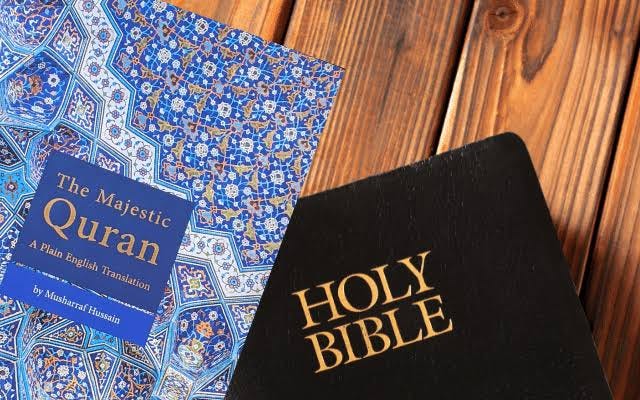
We can see this difference in how religious texts are treated. Psalm 137 speaks of taking children and dashing them against rocks. Yet most people do not read this verse and conclude that Christians are evil and scary individuals. Rather, they consider its historical setting, its literary genre, the surrounding passage, and the centuries of interpretation that followed. They correctly understand that a religious tradition cannot be reduced to its harshest sentence.
The problem is that this method often disappears when the Qur’an is discussed. Qur’an 9:5 is frequently quoted as saying, “Slay them wherever you find them,” while the surrounding verses are ignored. The passage concerns specific tribes that had violated their treaties with the Muslims. Verse 4 commands Muslims to honor their agreements with those who remained faithful, while verse 6 commands them to protect an enemy who seeks asylum and escort him to safety. Similarly, Qur’an 2:191 is quoted without the previous verse, which states: “Fight those who fight you, but do not transgress. Indeed, God does not love the transgressors.” The qualifications and restrictions are part of the passage, but they are removed from the presentation.
The double standard is very apparent: when people read the Bible, they consider context, look at the nuance in the verses, and examine different interpretive traditions. When they read the Qur’an, they isolate a verse, remove the surrounding sentences, and dismiss fourteen centuries of Islamic scholarship as an excuse. I am not arguing that the Bible is just as bad and Christians should therefore leave Muslims alone. My point is the opposite: Christians are correct to read difficult biblical passages in context, and the same framework should be applied to Islam and the Qur’an as well.
Even if Islam were completely false, taking verses out of context would not demonstrate its falsehood. A method that begins with a conclusion and then forces every piece of evidence to support it cannot reliably lead us to truth.
What I find strange is that ISIS reads the Qur'an the same way Robinson does. They pull a verse out of its passage, ignore what comes before and after it, and treat fourteen centuries of scholarship as though it were a cover story. ISIS does this because it needs the Qur'an to sound like a recruitment poster. Robinson does it because he needs it to sound like a threat. Neither of them can afford for you to read the whole thing.
Suspicion Is Not an Argument
This brings us back to the wording of the Oxford Union motion: should the West be “suspicious” of Islam? But what exactly does suspicion mean in the context of political, religious, and philosophical engagement? Suspicion is not the same as disagreement, criticism, or careful examination. A person may investigate Islam, reject its teachings, and present arguments against it without being suspicious of Muslims. Suspicion goes further. It assumes from the beginning that Islam is hiding something dangerous and that Muslims should be treated with distrust before their beliefs have even been fairly examined.
Once suspicion becomes the starting point, almost anything a Muslim does can be used as confirmation. If a Muslim commits a crime, it’s because of his religion. If a Muslim does something good, he did this good thing despite his religion. If he condemns terrorism, then he is lying. If he remains silent on terrorism, the silence is treated as support. Nothing can count against the original belief.
My invitation is therefore different from Robinson’s. I propose that we examine Islam rather than be suspicious of it. We should read the Qur’an, study the hadith reports, and seriously engage with the explanations provided by Muslim scholars. Obviously, there may be verses or hadiths that initially seem problematic or conflict with contemporary Western norms. However, rather than judging them at face value, we should examine how Muslim scholars have understood them and consider whether the Western norms being used to judge Islam are themselves always correct. After all, Western societies once defended racial segregation and treated black people as inferior to white people.
Much of my work focuses on taking religious claims seriously and critically examining them. I have always welcomed emails from people who think my religion is wrong and want to engage academically with my beliefs. I welcome examination of my religious beliefs, but the examination must be fair, and the same interpretive standards must be applied to Islam that are applied to other traditions.
I was born and raised in America. I am culturally European and a Muslim by conviction. Therefore, when someone asks whether the West should be suspicious of Islam, they are asking whether it should be suspicious of people like me: people who have gone through Western academia, were born and raised in Western society, and who, because of the freedom the West claims to protect, have chosen Islam over other religious ideologies.
We are Muslims, and we are also part of the West. So do not begin with suspicion. Begin with curiosity. Examine Islam and judge it according to the strength of its actual arguments.
That, after all, is supposed to be a Western value.
If you found this useful, I cover these questions in more depth on my YouTube channel — subscribe there for more on Islamic apologetics and philosophy of religion.